TARGET the Future: A Research Study - Effects of an 8-week School-Based Intervention Programme on Irish School Children's Fundamental Movement Skills
Dr Lisa Kelly
Researcher
Athlone Institute of Technology
TARGET the Future: A Research Study
Effects of an 8-week school-based intervention programme on Irish school children's fundamental movement skills.
Background
Fundamental movement skills (FMS) are described as the building blocks of physical activity, and include locomotor (e.g. run, gallop, skip), object-control (e.g. throw, catch, kick) and stability skills (e.g. single leg stance). Achieving proficient levels of FMS is associated with physical and mental health-related benefits including higher levels of physical activity and maintenance of a healthy weight status.
Engaging in regular physical activity during early childhood is essential to the development of proficient levels of FMS. However, only 17% of Irish primary school children are meeting the daily physical activity guidelines which indicates that many children have limited opportunities to develop their FMS.
As children get older and their cognitive awareness improves, they can more accurately perceive their ability to perform skills. Consequently, children with poorer FMS may lose confidence and motivation to continue participating in regular physical activity and sport which increases their risk of becoming overweight or obese and subsequently developing obesity-related diseases in later years.
Furthermore, females often demonstrate poorer levels of object-control skill proficiency than males whilst overweight children regularly struggle to a greater extent with locomotor skills compared to non-overweight children.
Primary PE lessons provide an opportunity for all children to engage in structured physical activity and in many instances may be the only form of physical activity that some children experience. It is therefore essential that the learning environment created by the teacher in PE lessons is motivating, engaging and inclusive for all children so that all are afforded the opportunity to master a broad range of FMS throughout the primary school years.
The aim of this study was to investigate if an 8-week FMS intervention programme, delivered using a mastery-motivational climate, can significantly improve FMS proficiency levels among primary school children. A secondary aim was to examine potentially differential intervention effects according to children's sex and weight status.
Methods
This study examined the immediate and long-term effects of an 8-week FMS intervention programme on 255 first- and second-class Irish school children's FMS proficiency levels. The study was split into two phases where in phase 1, children in two schools took part in the intervention while children in another two schools continued with their usual PE lessons. In phase two the groups swapped conditions so that the initial control group now engaged in the intervention and the initial intervention group returned to their usual PE lessons.
FMS proficiency, assessed using the Test of Gross Motor Development Third edition, and weight status based on body mass index (BMI) were recorded at five time points: pre and post phase one, pre and post phase two and at 13-months post-intervention.
Intervention Design
The intervention consisted of two 45-minute lessons per week which was delivered by an instructor with specialist knowledge in FMS. Skills targeted throughout the eight weeks included hop, jump, skip, slide, gallop, balance, throw, catch, kick, forehand strike, two-hand strike and basketball dribble. Each lesson consisted of a warm-up, two or three separate games or activities that targeted three specific FMS per lesson and a cool down.
Pedagogical Approach
Mastery motivation is a pedagogical approach that places the child at the centre of the learning experience. The aim of this approach is to enhance each child's intrinsic motivation to fully engage with a lesson. A child who is intrinsically motivated is focused on self improvement and not worried about comparing him/herself to peers. In this study, the instructor followed the TARGET principles to create a mastery-motivational climate in each lesson. TARGET stands for task, authority, recognition, grouping, evaluation and time.
Task
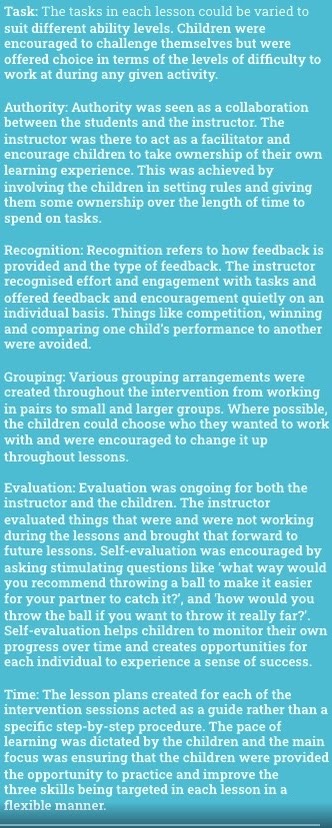
The tasks in each lesson could be varied to suit different ability levels. Children were encouraged to challenge themselves but were offered choice in terms of the levels of difficulty to work at during any given activity.
Authority
Authority was seen as a collaboration between the students and the instructor. The instructor was there to act as a facilitator and encourage children to take ownership of their own learning experience. This was achieved by involving the children in setting rules and giving them some ownership over the length of time to spend on tasks.
Recognition
Recognition refers to how feedback is provided and the type of feedback. The instructor recognised effort and engagement with tasks and offered feedback and encouragement quietly on an individual basis. Things like competition, winning and comparing one child's performance to another were avoided.
Grouping
Various grouping arrangements were created throughout the intervention from working in pairs to small and larger groups. Where possible, the children could choose who they wanted to work with and were encouraged to change it up throughout lessons.
Evaluation
Evaluation was ongoing for both the instructor and the children. The instructor evaluated things that were and were not working during the lessons and brought that forward to future lessons. Self-evaluation was encouraged by asking stimulating questions like 'what way would you recommend throwing a ball to make it easier for your partner to catch it?', and 'how would you throw the ball if you want to throw it really far?'. Self-evaluation helps children to monitor their own progress over time and creates opportunities for each individual to experience a sense of success.
Time
The lesson plans created for each of the intervention sessions acted as a guide rather than a specific step-by-step procedure. The pace of learning was dictated by the children and the main focus was ensuring that the children were provided the opportunity to practice and improve the three skills being targeted in each lesson in a flexible manner.
Findings
The intervention led to significant improvements in FMS proficiency levels immediately post intervention when compared to the class doing their usual PE lessons. Both groups demonstrated significantly higher FMS proficiency at 13-month follow-up compared to their baseline scores. Importantly, there were similar improvements in FMS for all children regardless of sex or weight-status.
However, males had significantly better object-control skill scores than females at each time point and non-overweight children remained significantly better than overweight children at both locomotor and object-control skills. Importantly however, the gap did not increase suggesting that the intervention was suitable for all children regardless of sex or weight status and may be a suitable strategy when teaching PE to a group of children with diverse interests and needs.
Take Home Message
Teaching PE to groups of children who are diverse in terms of their ability, interests and needs can be difficult. This study suggests that incorporating the TARGET principles to create a mastery motivational climate may be an effective pedagogical approach to maximise student engagement and enhance children FMS proficiency levels in primary PE lessons.
"TARGET stands for task, authority, recognition, grouping, evaluation and time"
Dr Lisa Kelly* *Athlone Institute of Technology