Sport Education: An Alternative Approach to Teaching PE - Creating Lifelong Learners
Aoife McGovern
Primary School Teacher
PDST PE Team & Hibernia College
'Sport Education' An Alternative Approach to Teaching PE - Creating Lifelong Learners
Sport Education is a relatively new curriculum and instruction model, developed in the 1990's by Daryl Siedentop. It was designed to provide students with authentic experiences that are thorough and enjoyable and that contribute to their desire to become and stay physically active throughout their lives. As primary teachers, I believe that this should be our main priority, ensuring that our students have the skills to get active and remain active throughout their whole lives. The beauty of this model, in my opinion, is that it caters for all needs in the classroom. The students work in mixed ability groups for the entire 'season'.
Seasons or Units last for a number of weeks, depending on the needs and time availability of the class. They typically start with small competitions between teams and builds up to a culminating event. Children learn multiple roles associated with sports, depending on the activity chosen, as well as skills development as a player.
The roles include: captain, coach, equipment manager, referee, scorekeeper and statistician. If there was a bigger group other roles could be included such as: warm-up and cool-down officer, skills coach etc. I have always incorporated this into the teaching of the games or athletics strands but it can be adapted for any strand thanks to its flexibility.
Objectives for Each Sport Education Season
The following objectives would be pursued during each Sport Education season:
- Develop sport-specific techniques and fitness - Appreciate and be able to execute sport-specific strategic play - Participate at a developmentally appropriate level - Share planning and administration of sport experiences - Provide responsible leadership - Work effectively with your team to pursue common goals - Appreciate the rituals and conventions that give sports their unique meanings - Develop the capacity to make reasoned decisions about sport concerns - Develop and apply knowledge about umpiring, refereeing and training - Become involved with sport and physical activity outside of school
When engaging in a Sport Education Season, the student has the opportunity to learn the given activity/sport to a greater depth than is typical in a multi-activity PE programme. Seasons are designed to last long enough for the students to learn and grow in the various outcomes and roles expected of them. In the National Curriculum trial of Sport Education in Australian schools, the recommended format was 2 sessions a week for 10 weeks. With my various class groups I incorporated a season in 4, 6 or 8 weeks, depending on the activity/sport. One year the Rugby World Cup was coming up, so we decided to take a 'World Cup' approach.
Another year we had an 'Athletics Olympics'. I like to integrate and relate our learning to what's happening in the sporting world, but this is not essential. No two seasons has ever been the same for me and the students should always guide the design of the season. The teacher and students should discuss what they want to achieve over the period of time covered in the Season. Teacher can recap on skills used/needed for the chosen sport or activity. Once the class has decided on activities or a particular sport to be covered in the season (guided by the teacher) and the teams are made, you are good to go!
Getting Started
- Sport/Activity: Choose the sport(s) that you wish to focus on - Space: where will it take place (indoor/outdoor) - Equipment: depending on the activity chosen - Length of season - Teams: mixed ability teams - Roles: depending on the amount on each team, let the children decide which roles are needed the most e.g. players, coach, captain, equipment manager, fitness leader etc. - Content/Skills: which skills will be covered in the season? - Culminating event: how will the season end? (League system: gathering points every week, knock out system on the last day, round robin, World Cup finals, Olympics etc.) - Awards: decide on the awards near the beginning so that pupils have something to focus on
Sample Season
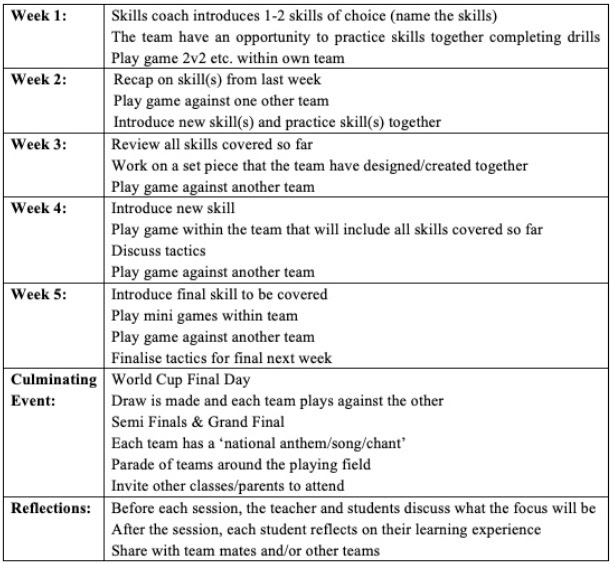
Each week, a set time will be given to students to create a list of equipment needed, gather the equipment, set up their area, do a warm up, complete session, cool down, tidy up area, reflect on the session. The teacher acts as a facilitator in every session, circulating between the teams. The teacher will meet with the skills coach at the beginning of each session to recap on skills being covered. The roles, which have been decided at the beginning, will rotate each week. Each team will have a name and a colour. The students will keep a Journal to reflect on each session.
**Week 1:** Skills coach introduces 1-2 skills of choice (name the skills). The team have an opportunity to practice skills together completing drills. Play game 2v2 etc. within own team.
**Week 2:** Recap on skill(s) from last week. Play game against one other team. Introduce new skill(s) and practice skill(s) together.
**Week 3:** Review all skills covered so far. Work on a set piece that the team have designed/created together. Play game against another team.
**Week 4:** Introduce new skill. Play game within the team that will include all skills covered so far. Discuss tactics. Play game against another team.
**Week 5:** Introduce final skill to be covered. Play mini games within team. Play game against another team. Finalise tactics for final next week.
**Culminating Event:** World Cup Final Day. Draw is made and each team plays against the other. Semi Finals & Grand Final. Each team has a 'national anthem/song/chant'. Parade of teams around the playing field. Invite other classes/parents to attend.
**Reflections:** Before each session, the teacher and students discuss what the focus will be. After the session, each student reflects on their learning experience. Share with team mates and/or other teams.
Opportunities for Integration
- **Art:** Create a team flag/logo, make and design clay medals/trophies - **Music:** Compose a chant/song/anthem - **SESE:** Complete a country profile - **Language:** Write an acceptance speech, a welcome note for final day, a captain's motivational speech, reflective diaries - **Maths:** Record measurements/times, analyse the data, compare to other teams - **SPHE:** Reflective diaries: how did it feel, how have you developed etc.
The first and most important role is that of the player. Actively taking this role means making a significant contribution to one's team and to the competition. This involves giving a good effort in trying to learn techniques and tactics, playing competitively and fairly, supporting teammates, respecting opponents and officials and having fun! In Sport Education, all students get equal opportunity to play and to be a part of a team.
What Did the Students Say?
"I loved being the referee. I don't have skills as good as some of the others but everyone listened to me when I blew the whistle, it was great!"
"I play lots of sports and my favourite role was being team captain. I didn't think I'd like the other roles but I did! I had no idea how much work needs to be done behind the scenes. I admire all the people in our club who do those jobs. Maybe they weren't such good players but still wanted to be involved in the club."
"The Final Day was the best! The other classes came to watch us and everyone loved our chant. We didn't win the final but someone on our team got best referee. We were delighted!"
References
Siedentop, D., Hastie, P.A., and Van Der Mars, H. (2011). Complete Guide to Sport Education, Second Edition.
About the Author
Aoife is a primary school teacher from Waterford. She recently took a career break and spent 5 years teaching in Dubai. She also took this opportunity to travel to many countries and loved everything about living in the Middle East.
Aoife is an avid sports player, having represented her club and county in ladies gaelic football and her club and province in hockey. These days she enjoys tennis, golf and swimming.
Physical Education is an integral part of Aoife's life. She is involved with the PDST PE team, facilitating workshops for other primary teachers and she is also on the PE team in Hibernia College. She completed a Masters in Education and focused on mentoring primary teachers in the teaching of PE. Aoife is passionate about encouraging each and every child to become physically active and to remain so, for the rest of their lives.